
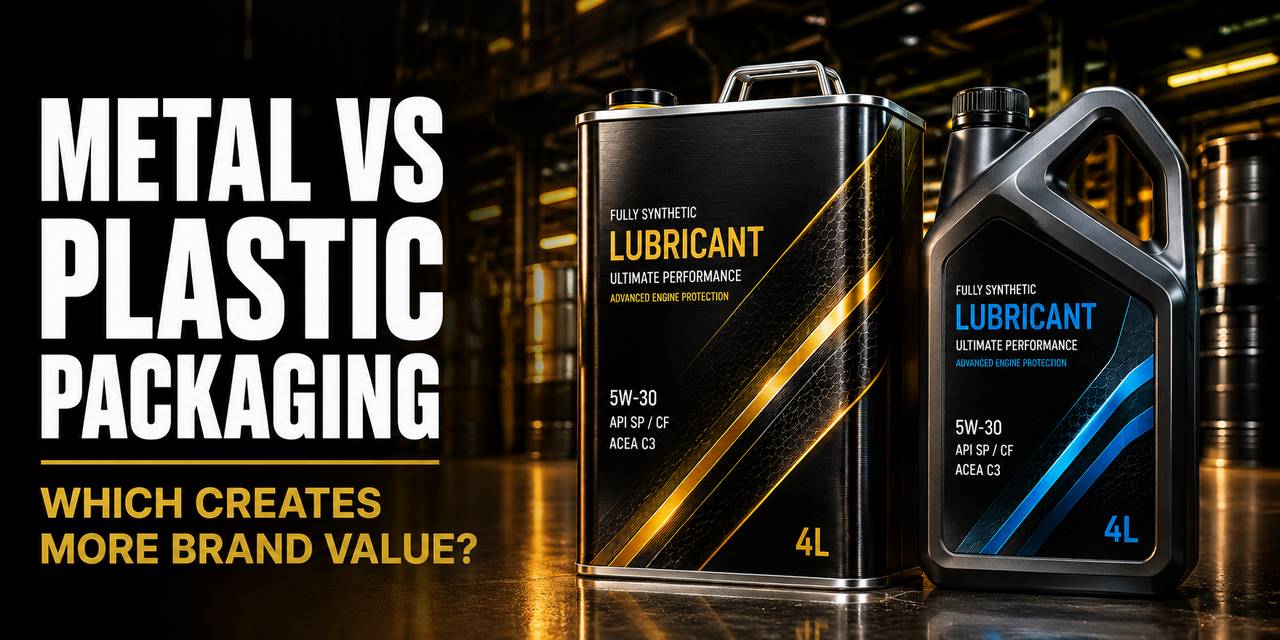
When lubricant brands evaluate packaging options, the discussion often focuses on cost, durability, and logistics. However, packaging materials influence much more than operational efficiency. The debate between metal vs plastic packaging affects customer perception, premium positioning, export readiness, and long-term brand value. In competitive industrial markets, packaging frequently becomes one of the first indicators of product quality. This article explores how metal and plastic packaging compare from a branding, production, and marketing perspective, helping manufacturers choose the packaging strategy that best supports their business objectives.
For many lubricant manufacturers, packaging material selection begins with practical considerations.
Questions often focus on:
While these factors are important, they represent only part of the decision-making process.
Packaging material also influences how customers perceive the product.
A container is more than a protective shell.
It is one of the first physical interactions a customer has with a brand.
Before the lubricant is tested, before technical specifications are reviewed, and before performance claims are evaluated, customers are already forming impressions based on the packaging itself.
This reality makes packaging material an important branding decision.
The choice between metal and plastic packaging can affect:
As industrial markets become increasingly competitive, these factors are becoming more influential than ever.
Brands that understand the relationship between packaging and perception often gain a meaningful advantage over competitors focused solely on production costs.

Industrial buyers are often viewed as purely rational decision-makers.
In reality, perception still plays a significant role.
People naturally associate visual and tactile cues with quality.
This psychological effect exists across nearly every industry.
In the lubricant sector, packaging can communicate:
A heavy metal container may suggest durability and premium quality.
A well-designed plastic package may communicate convenience and innovation.
Neither perception is automatically right or wrong.
However, both influence purchasing behavior.
This is why leading lubricant manufacturers increasingly treat packaging as part of their overall branding strategy rather than merely a production requirement.
Different packaging materials support different market positions.
For example:
Premium lubricant brands often favor packaging that reinforces quality and exclusivity.
Value-focused brands may prioritize efficiency and accessibility.
The material itself becomes part of the brand story.
As discussed in our previous articles on Lubricant Packaging Design and Motor Oil Packaging Design Trends, successful packaging systems align material choices with business objectives.
The strongest brands create consistency between:
When these elements work together, packaging becomes a strategic asset rather than a simple container.
In Part 2, we will examine the specific advantages of metal and plastic packaging, explore production considerations, and compare how each material performs in real-world lubricant markets.
Metal packaging has long been associated with premium industrial products.
In the lubricant industry, metal containers continue to communicate qualities that many brands want customers to associate with their products:
These perceptions are not accidental.
Metal packaging feels different.
It looks different.
And most importantly, customers often interpret those differences as indicators of product quality.
This is one of the reasons why many premium lubricant brands continue to invest in metal packaging despite the availability of lower-cost alternatives.
From a branding perspective, metal containers offer several advantages.
Metal packaging naturally communicates value.
The weight, texture, and visual appearance of metal often create a stronger sense of quality compared to plastic alternatives.
Metal surfaces interact with light differently, creating visual depth and sophistication that can improve product visibility.
In many international markets, metal packaging continues to be associated with higher-quality industrial products.
Premium brands often benefit from packaging that reinforces quality expectations throughout the customer experience.
These advantages make metal packaging particularly attractive for lubricant manufacturers seeking to strengthen their market position..
Although metal packaging offers strong branding benefits, plastic packaging remains extremely popular across the lubricant industry.
Its success is driven by several practical advantages.
For many manufacturers, plastic packaging provides:
Plastic containers can often be produced at higher volumes and lower costs, making them attractive for brands operating in highly competitive markets.
Modern plastic packaging has also improved significantly.
Advances in material technology now allow manufacturers to create containers that appear more sophisticated than earlier generations of industrial packaging.
As a result, many brands successfully use plastic packaging while maintaining a professional image.
However, achieving premium perception with plastic packaging typically requires stronger branding, higher-quality graphics, and more refined design execution.
The packaging itself does not automatically communicate premium value in the same way metal often does.
Choosing between metal and plastic packaging involves more than marketing.
Production realities also play an important role.
Manufacturers must evaluate factors such as:
Metal packaging may offer stronger brand perception, but it can also introduce additional production considerations.
Plastic packaging may improve operational efficiency, but it may require greater branding investment to achieve the same premium positioning.
The optimal choice depends on the company’s objectives.
Brands focused on premium positioning often prioritize perception.
Brands competing primarily on volume and price may prioritize efficiency.
The most successful packaging strategies align material selection with overall business goals.
One of the biggest mistakes companies make is focusing exclusively on packaging cost.
Packaging should be evaluated based on value creation rather than material cost alone.
A slightly more expensive package that improves customer trust, strengthens brand perception, and supports premium pricing may generate significantly greater long-term returns.
This is especially true in industrial markets where reputation and perceived quality strongly influence purchasing decisions.
The key question is not:
“Which material is cheaper?”
The more strategic question is:
“Which material best supports our brand positioning?”
In Part 3, we will compare how metal and plastic packaging influence customer perception, explore export-market considerations, and examine how sustainability trends are changing the packaging conversation across the lubricant industry.requirements, and emerging technologies that are transforming motor oil packaging design across global markets.
When customers evaluate lubricant products, they rarely assess technical specifications first.
Instead, they form an initial impression based on what they can immediately see and touch.
Packaging plays a critical role in shaping that perception.
This is where the debate between metal and plastic packaging becomes particularly important.
Both materials can protect the product effectively.
However, they communicate very different messages.
Metal packaging is often associated with:
Plastic packaging is commonly associated with:
Neither perception is inherently better.
The question depends on the brand’s positioning strategy.
A premium lubricant manufacturer seeking to compete in higher-value market segments may benefit from the authority that metal packaging naturally communicates.
A value-oriented brand focused on volume and accessibility may find plastic packaging more aligned with its objectives.
The most successful packaging systems create consistency between product positioning and packaging material.
When packaging supports the brand message, customer trust becomes easier to establish.
Export markets introduce additional challenges that go beyond domestic distribution.
Products may travel thousands of kilometers, pass through multiple warehouses, and compete against international brands with strong packaging systems.
In these environments, packaging often becomes a silent salesperson.
Distributors, retailers, and end users frequently evaluate packaging quality before evaluating the product itself.
Metal packaging offers several advantages in export scenarios:
These qualities can help brands establish credibility in unfamiliar markets.
Plastic packaging also offers important export advantages:
The decision ultimately depends on the export strategy.
Brands targeting premium international segments often favor metal packaging because it reinforces quality expectations.
Brands prioritizing large-scale distribution may benefit from the operational advantages of plastic packaging.
The most effective solution aligns packaging material with market objectives.
Sustainability has become one of the most influential topics in packaging development.
Customers, regulators, and international markets increasingly expect manufacturers to reduce environmental impact while maintaining product performance.
Both metal and plastic packaging present opportunities and challenges.
Metal packaging is often valued because:
Plastic packaging continues to evolve through:
The sustainability discussion is becoming more nuanced.
Rather than asking which material is universally better, manufacturers are increasingly evaluating which solution performs best within their specific supply chain and market conditions.
As a result, sustainability decisions are becoming more strategic and data-driven.
One of the most overlooked aspects of packaging material selection is trust.
Customers frequently use packaging quality as a shortcut for evaluating product quality.
This psychological effect is particularly strong in industrial sectors where buyers may have limited opportunities to test products before purchase.
A package that appears premium often creates expectations of premium performance.
A package that appears economical may create expectations of cost-focused positioning.
Because of this relationship, packaging material becomes more than an operational decision.
It becomes a brand strategy decision.
Companies that understand this connection are often better positioned to create packaging systems that strengthen customer confidence and support long-term brand growth.
In Part 4, we will answer the central question of this article: Which packaging material creates more brand value? We will provide strategic recommendations, practical guidance for lubricant manufacturers, a conclusion, frequently asked questions, and final insights for choosing the right packaging strategy.
After comparing production factors, customer perception, export requirements, and sustainability considerations, we arrive at the central question:
Which packaging material creates more brand value?
The answer depends on the brand’s objectives.
If the primary goal is operational efficiency, lower logistics costs, and large-scale production, plastic packaging often provides significant advantages.
However, if the goal is premium positioning, stronger perceived quality, and enhanced brand authority, metal packaging frequently delivers greater value.
This distinction is important.
The question is not which material is technically better.
The question is which material better supports the desired market position.
For many premium lubricant manufacturers, metal packaging offers advantages that extend beyond functionality.
It helps communicate:
These perceptions can influence purchasing decisions long before a customer experiences the product itself.
This is why many high-end lubricant brands continue investing in metal packaging despite higher production costs.
They recognize that packaging contributes directly to brand value.
Every lubricant company operates within different market conditions.
Because of this, packaging decisions should always support broader business objectives.
Some manufacturers successfully combine both materials across different product categories.
Premium product lines may use metal packaging while value-oriented products remain in plastic containers.
This approach allows brands to balance operational efficiency with market positioning.
The key is maintaining consistency between packaging choices and brand strategy.
One of the biggest shifts occurring across industrial markets is the growing recognition that packaging is part of the customer experience.
Historically, packaging was viewed as a protective requirement.
Today, it is increasingly viewed as a strategic communication tool.
Packaging influences:
In many cases, customers encounter the package before they encounter the product.
Because of this, packaging becomes one of the most visible expressions of a company’s standards and values.
The strongest industrial brands understand that packaging should not merely contain the product.
It should support the brand.
The debate between metal vs plastic packaging is not simply a question of materials.
It is a question of strategy.
Both packaging formats offer meaningful advantages.
Plastic packaging provides efficiency, flexibility, and cost benefits.
Metal packaging delivers stronger premium perception, greater visual impact, and enhanced brand authority.
The most effective packaging choice depends on the goals of the business, the expectations of customers, and the positioning of the brand.
For lubricant manufacturers seeking premium market perception and stronger differentiation, metal packaging often creates greater long-term brand value.
For brands focused on operational efficiency and volume distribution, plastic packaging can provide important competitive advantages.
Ultimately, successful packaging decisions are those that align material selection with business objectives, customer expectations, and long-term growth strategies.
Not necessarily. Metal packaging often provides stronger premium perception, while plastic packaging offers operational and cost advantages.
Metal packaging is frequently associated with quality, durability, and engineering excellence, helping reinforce premium brand positioning.
Yes. Plastic packaging generally offers lower production costs and reduced transportation weight.
Both can perform well. Metal packaging often creates stronger premium perception, while plastic packaging can improve logistics efficiency.
Yes. Customers often associate packaging quality with product quality and brand credibility.
Metal packaging generally provides stronger visual presence due to its material characteristics and premium appearance.
Metal is highly recyclable, but sustainability depends on the complete lifecycle and supply chain of the packaging system.
Yes. High-quality design, printing, and branding can significantly improve the perceived value of plastic packaging.
In some cases, a hybrid strategy can be effective, using different materials for different product lines and market segments.
The most important factor is alignment between packaging choice, brand positioning, customer expectations, and business goals.
At Jahanifar Studio, we help industrial brands develop packaging systems that combine strategic branding, production expertise, and premium market positioning.
Whether your products are packaged in metal or plastic, the goal remains the same: creating packaging that strengthens customer trust, enhances brand value, and supports long-term business growth.
Discover how strategic packaging design can transform the way customers perceive your products and your brand.
Let's discuss your goals and explore the best path forward.